Word Tree: Transformers Edition
Desktop Version | 13 July, 2021
Trajectories are intriguing
Background
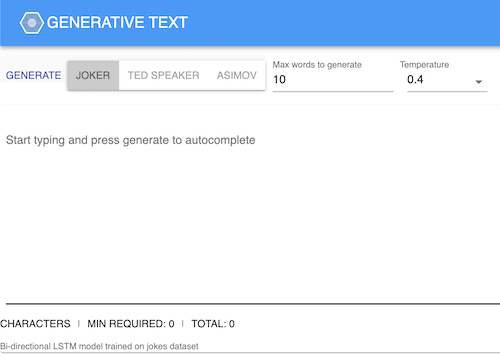
The first version of Word Tree visualized the model trained as part of Neural Text Generation post. It showed the words sampled from a set of small RNN based models trained on various corpora such as Asimov, Jokes, etc. The models were trained along the lines of Karpathy's post on Unreasonable Effectiveness of Recurrent Neural Networks must-read
The demo model used in the neural text generation post was very limiting in terms of their generative capabilities, i.e., consistently producing meaningful suggestions. Nonetheless, it was fascinating to see it uncover the structure of the language. The motivation behind the demo app was to try and create a specialized version of the model that could provide task or domain-specific suggestions. For example, a model to assist in writing jokes or, to auto complete science fiction stories in the style of great Isaac Asimov.
The model architecture will be considered infant compared to the transformers era in terms of the number of parameters, model capacity, and training costs.
2017: Neural Text Generation Demo Web App (Click Here)
About The Video
The tree in the video visualizes a few sampled trajectories generated using a language model. We use nucleus sampling to sample the model predictions and generate the sentence. The previous version of word tree used beam search. In general, nucleus sampling tends to generate diverse as well as better quality text.
By sampling text from the dynamic nucleus of the probability distribution, which allows for diversity while effectively truncating the less reliable tail of the distribution, the resulting text better demonstrates the quality of human text, yielding enhanced diversity without sacrificing fluency and coherence.
Source: The Curious Case of Neural Text Degeneration (i.e. The Nucleus Sampling Paper)
See Also
How does it work?
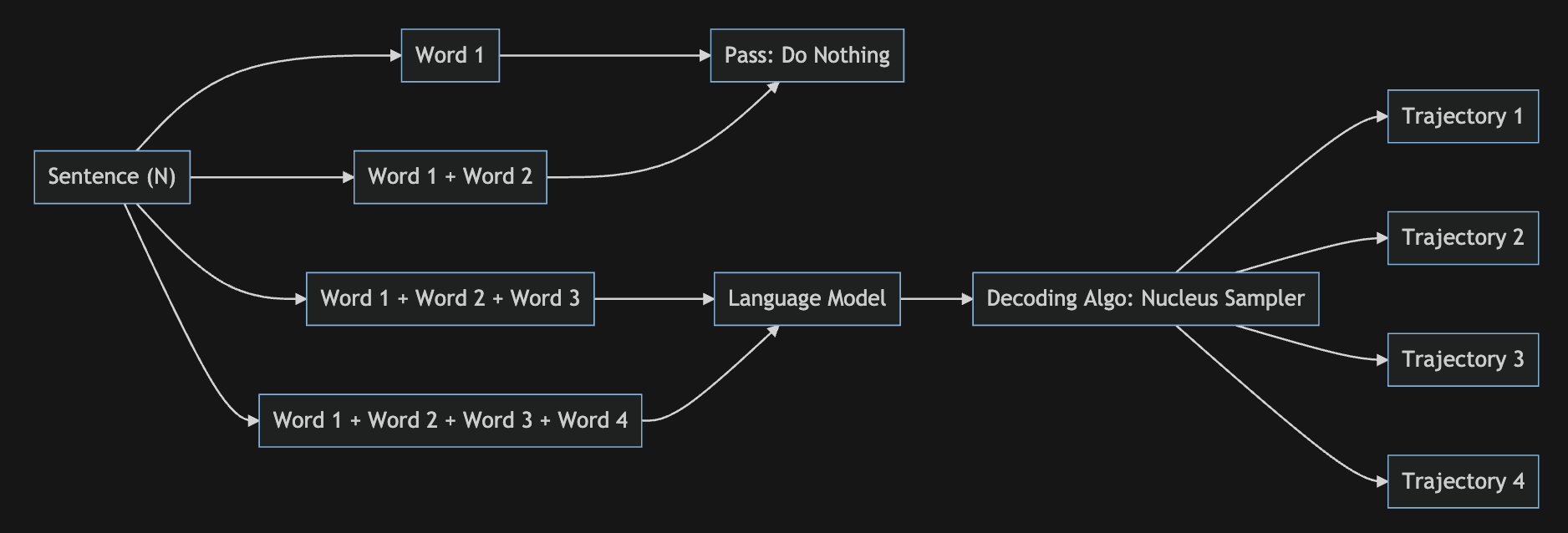
At the very high level, this is how it works:
- Split sentences into individual sentence
- Split each sentence into words
- For every word in a sentence, concatenate with previous words and pass through the language model
- Decode the model predictions to generate a complete sentence
TODO: Add animated version with an example
Points worth mentioning:
- ⇢ Why aren't we passing the first two words to the model? Well, technically, we could but having more context helps the model provide better predictions.
- ⇢ We can swap out the language model with any domain-centric or next state-of-the-art model
- ⇢ We can swap the decoding algorithm as well
- ⇢ What do you mean by trajectory? The trajectory here is the path taken by the sentence. Each trajectory is created by repeatedly sampling the next word until the stopping criteria is met.
Plots
Why does the sun go on shining?
Why does the sea rush to shore?
Don't they know it's the end of the world?
'Cause you don't love me any more
Interestingly, the trajectories in last plot mostly converge to the same word. P(more | you don't love me any) is most likely going be higher than other words in the vocabulary. We also see one of the most common issues with decoding algorithms where they are stuck repeating themselves. And, some of the sentences will not make sense.
The following video is another take on the same song but this time we use image generation model (CLIP + GAN) to generate the background images. Each image was generated based on the sentence you see on screen.
Updated Video: Word Tree + Generative Image Model
Both the videos were created by manually aligning the song to the tree animation. What will be cool? Automatically aligning the audio and animation using word boundary detection.
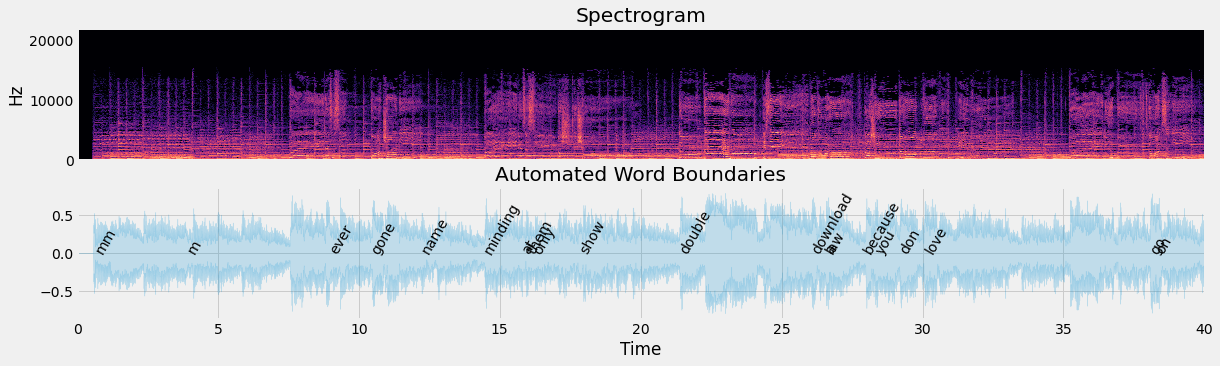
Or do something even cooler:

But I am going to stop here. Hoping to see it in action some day.
Trajectories are intriguing
Of many choices available, only one that ever gets chosen. The rest become could've, should've, or would've. Every step, every moment, every decision presents many possible paths - infinitely branching. Some more likely than the others. But one must choose.
Trajectories are fascinating
No language models were used to write this one
If you wish to explore more about sampling trajectories:
Up Next
Back to the demo app that has been in works for a few months now